We tested and ranked the 10 best AI agent builders of 2026 on ease of use, price, and power. See which one fits your team.

It's time to build your team of AI agents
I build AI agents all day every day. I've taught tens of thousands of people how to build AI agents on LinkedIn and YouTube, and I've directly helped thousands of customers set up their own AI agents.
In my day job, I'm the founder of a small company, but I'm also the sales team, the marketing team, the HR team, the finance team, the support team, and more. And this is only possible because I have dozens of AI agents working for me! AI agents are not just hype, and they're not just for AI experts. They're real, they're incredibly valuable, and anyone can create one. So now is the time to build your team of AI agents!
To get started, you need to pick which AI agent builder you'll use. In this article, I'll walk you through the 10 best platforms available, freshly updated for 2026.
TL;DR
To give you a quick overview, here are our top picks:
Relay.app: The best pick for most people. It's the most intuitive way to build reliable AI agents, with best-in-class chat-based editing, access to top AI models with AI credits, and human-in-the-loop controls.
Gumloop: A powerful visual canvas for multi-agent orchestration, great for technical teams who want AI-native building.
Zapier: Best for teams who need a wide library of integrations (they've got 8,000+ apps!) to connect niche or legacy tools and enterprise-level support.
Relevance AI: Purpose-built for sales and GTM teams, with pre-built agent templates for BDR and inbound workflows.
n8n: Ideal for developers who want full control and code-level customization on an open-source and self-hostable platform.
Cassidy: Best for teams that need AI agents deeply grounded in internal company knowledge and documents.
Make: A powerful visual canvas for power users who want granular control over complex automation logic.
Stack AI: Enterprise-focused with HIPAA, SOC 2, and on-prem deployment for regulated industries.
Lindy: Best for people looking for an AI executive assistant who can manage their inbox, calendar, and meeting management (all via iMessage!).
Tray: An enterprise iPaaS with AI agent building for IT teams managing complex, governed stacks.
How I evaluated these platforms
Before diving into the rankings, here's what I looked for, and what you should care about too.
Ease of use – A non-technical person should be able to create their first working agent in under 30 minutes without getting frustrated. G2's 2026 data shows ease of use is one of the top factors buyers mention when reviewing AI agent builders, and I weighted it heavily.
Human-in-the-loop controls – This is non-negotiable. AI agents that run without oversight will eventually make expensive mistakes. I evaluated how easy it is to add approval steps, review outputs, and maintain control.
AI model quality and flexibility – The best platforms let you use multiple AI models (OpenAI, Anthropic, Gemini, and more) without managing your own API keys. Multi-model support matters because different models excel at different tasks.
Integrations – The number of integrated tools is important, but it's much more important that the integrations work well. The agent needs to be able to do real work reliably in all of a user's tools.
Multi-agent orchestration – In 2026, single-agent setups aren't enough for complex workflows. I looked at how well each platform supports coordinating multiple specialized agents that hand off work to each other.
Security and governance – Especially important for teams in regulated industries. I looked at compliance certifications (SOC 2, HIPAA, GDPR), data residency options, access controls, and MCP governance.
Trust and reliability – Does it work consistently and predictably on a wide variety of real-world tasks.
For all of these, I combined my personal experience using the products with sentiment from real user reviews on sites like G2 and Product Hunt.
The 10 best AI agent builders in 2026
1.
Relay.app
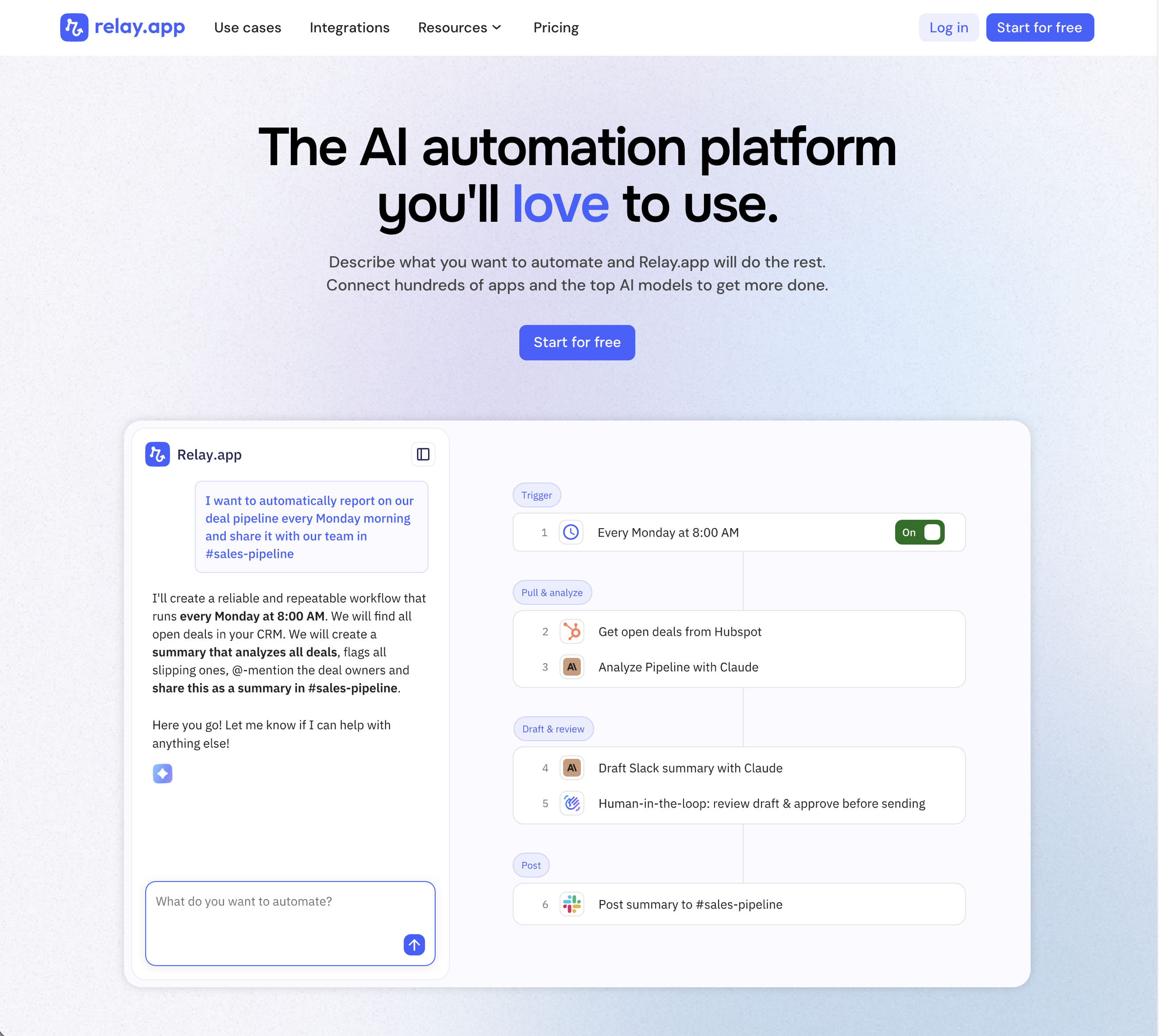
Relay.app is the most intuitive way to automate with AI. Just describe what you want to automate, and Relay.app will build a reliable, visual workflow for you. Relay.app connects with 200+ apps and all the top AI models. Non-technical users who have struggled with less user-friendly tools like Zapier or Make can easily create AI workflows in minutes, while longtime automation experts have all the advanced tools they need to build complex flows.
Product details
Designed to be intuitive to use: Relay.app is thoughtfully designed for individuals and teams of all technical abilities, from novice to expert.
An AI assistant optimized to build workflows for you: Chat with the AI assistant to build, test, and optimize workflows. It will proactively spot issues and make suggestions for you.
Hundreds of native integrations, plus custom API calls: 200+ deeply built, first-class native integrations. Don't see your app on the list? Just describe what you need and Relay.app's AI assistant will write a custom API call for you.
Collaborative building: Share workflows and app connections across your team for seamless multiplayer automation.
Human-in-the-loop oversight: Bring a teammate in when you need real life approvals, data entry, or manual review.
Universal AI credits for any AI model: Access the best models from OpenAI, Anthropic, and more using included AI credits.
Predefined processes for token efficiency: Set up a token-free structure for repeated work and limit AI tool calls to just the places you need them.
Technical power: Advanced users can go further with rich native tables, custom JavaScript steps, MCP servers, and custom HTTP requests.
Pricing
Relay.app's plans scale with your usage and team, starting with a generous free tier. All plans include free test runs that refresh every week so you can make sure everything works perfectly before you start paying.
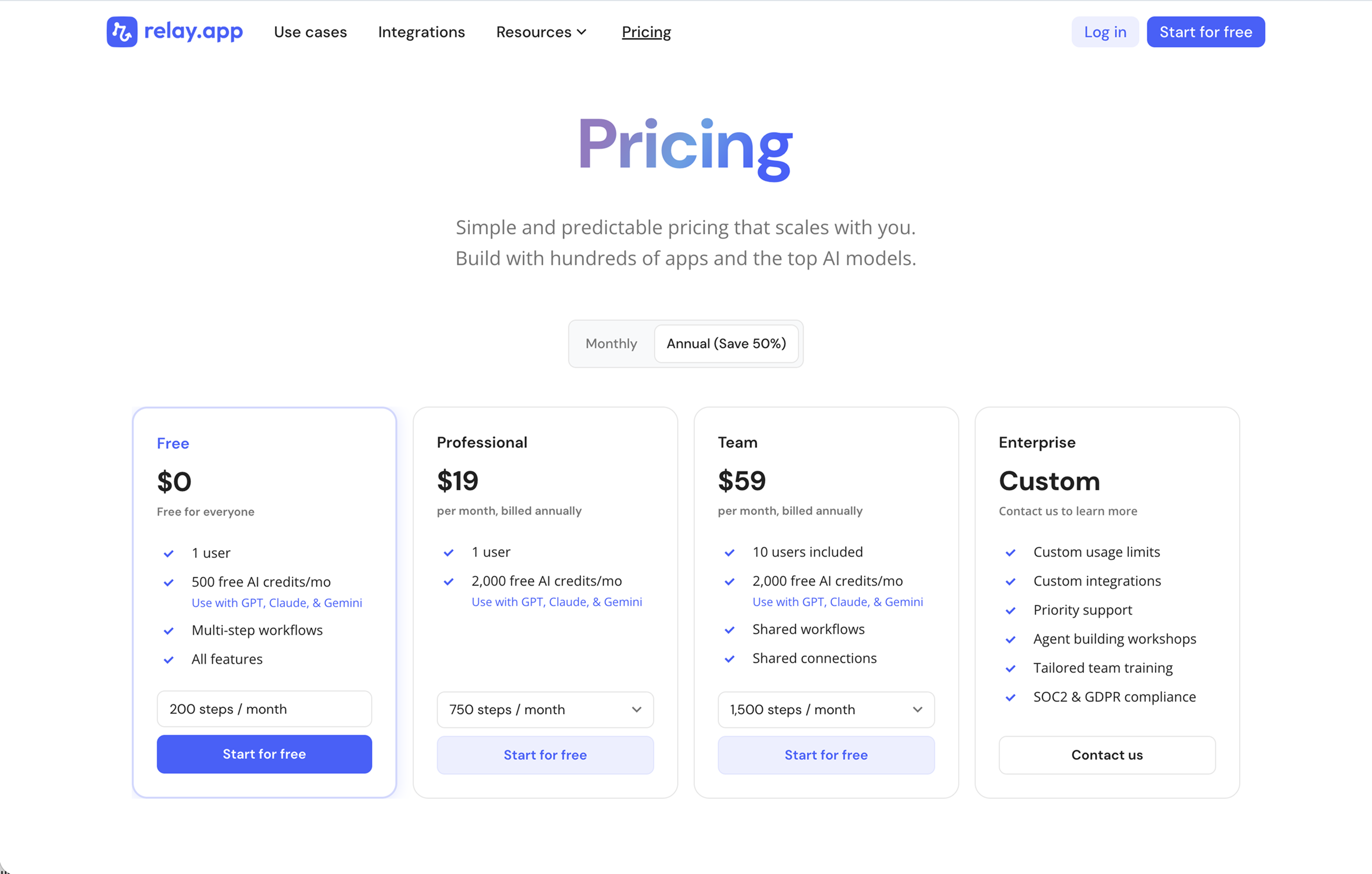
Free: $0/month for 1 user, 200 steps, and 500 AI credits
Professional: $19/month (billed annually) for 1 user, 750 steps, and 2,000 AI credits
Team: $59/month (billed annually) for up to 10 users, 1,500 steps, and 2,000 AI credits
Enterprise: Custom pricing for organizations with advanced usage or security requirements
2.
Gumloop
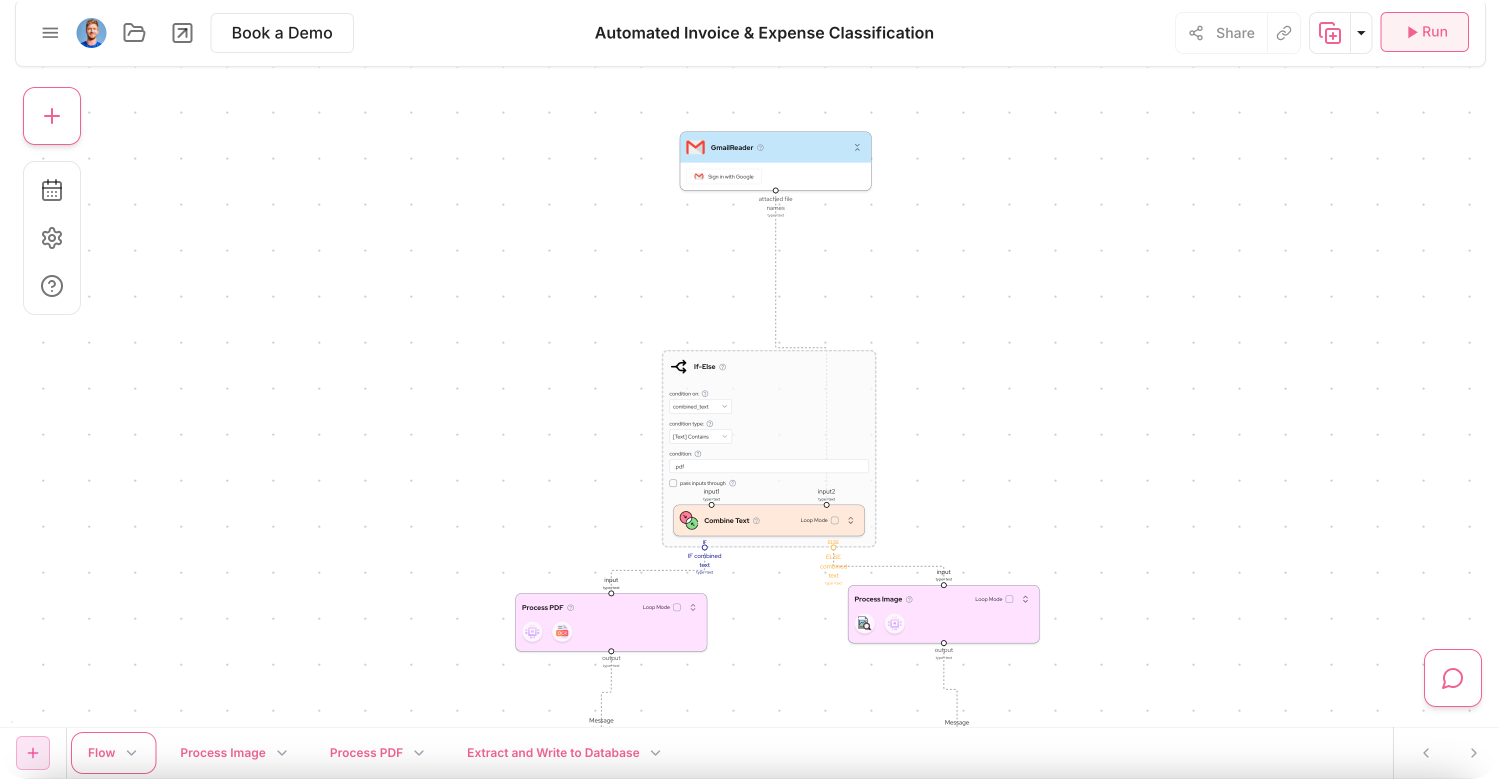
Gumloop is a no-code AI automation platform that enables teams to build, deploy, and manage specialized AI agents using a visual canvas. It lets users easily drag, drop, and connect modular nodes to orchestrate multi-agent workflows for functions like sales, support, and data analysis. The platform provides built-in access to multiple leading AI models without vendor lock-in and features native workspace integrations, MCP server support, and enterprise-grade security.
Product details
Multi-agent orchestration: Build and connect specialized AI agents using a visual drag-and-drop canvas.
AI model access: Access models from OpenAI, Anthropic, Gemini, and DeepSeek directly out of the box.
Workspace integrations: Interact with your built agents like co-workers directly within Slack or Microsoft Teams.
Enterprise security: Keep data secure with SOC 2 Type II compliance, VPC deployments, and role-based access control.
Gumstack AI gateway: Monitor, audit, and analyze AI chats and internal data access across your organization.
Data connectivity: Connect workflows to internal and external data sources like PostgreSQL, Snowflake, and Datadog.
MCP server support: Host or proxy Model Context Protocol servers to seamlessly trace and manage tool calls.
Usage monitoring: Track organization-wide credit usage in real time and implement budget controls.
Pricing
Gumloop offers a free tier to get started, with paid subscriptions scaling based on monthly credit usage and advanced features.
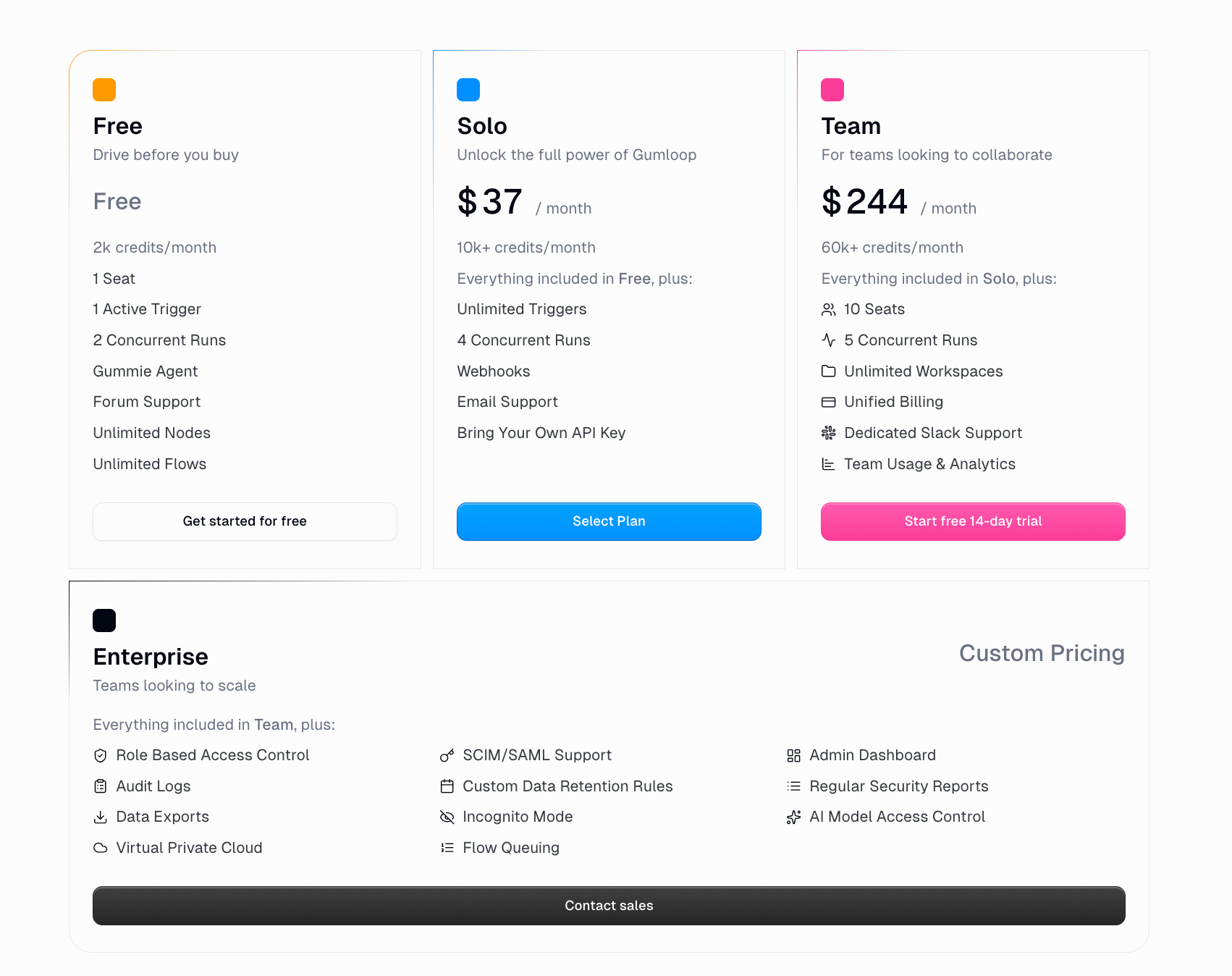
Free: $0/month for 5,000 credits, 1 seat, 1 active trigger, and 2 concurrent runs
Pro: $37/month for 20,000+ credits, unlimited seats, 5 concurrent runs, and MCP server proxying
Enterprise: Custom pricing for role-based access control, SCIM/SAML support, and virtual private cloud deployments
3.
Zapier
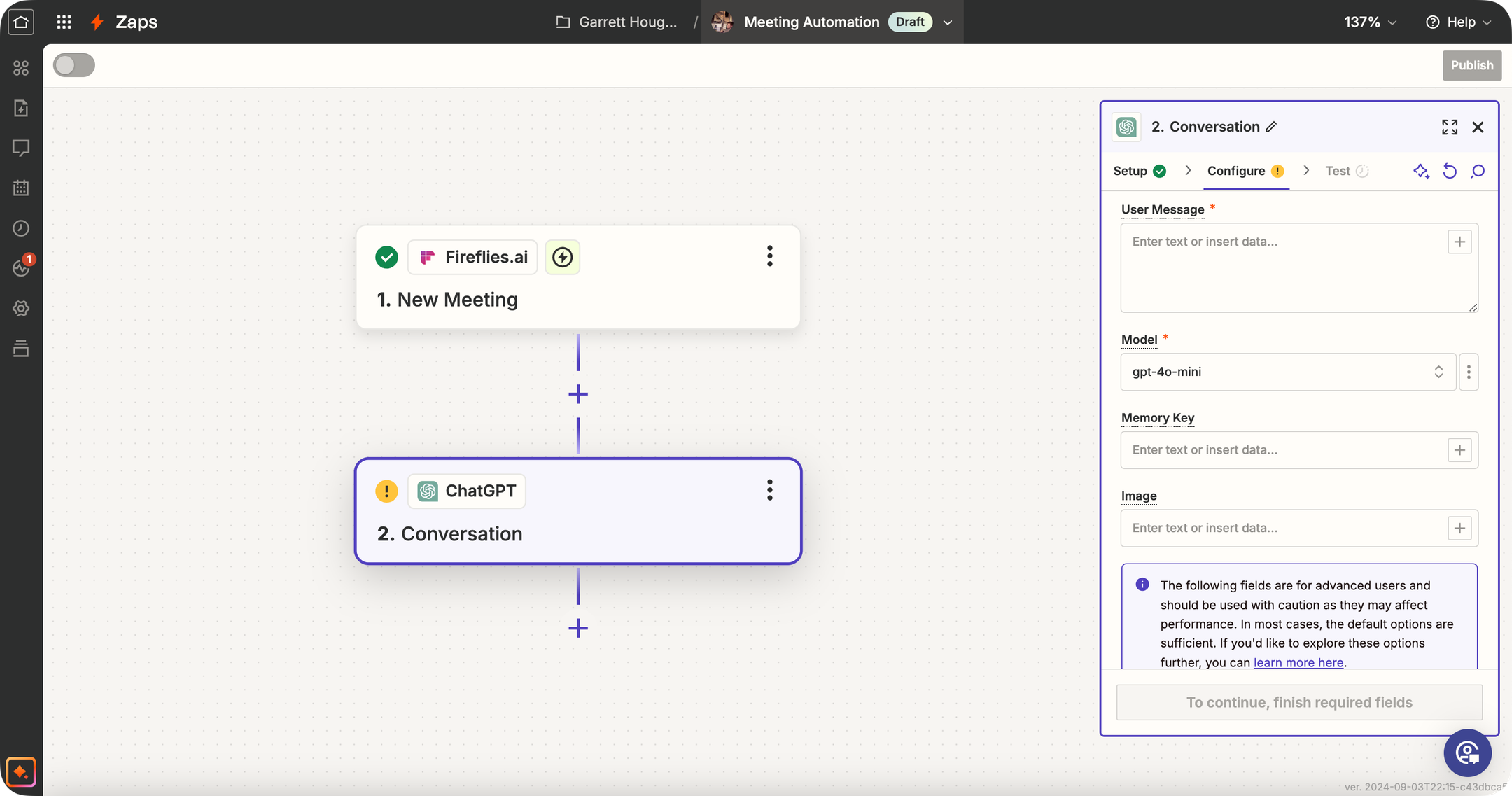
Zapier is one of the best-known automation tools (the "OG" of no-code workflows) that has significantly expanded its AI capabilities. Traditionally, Zapier connects your apps: "When X happens in app A, do Y in app B." Now, Zapier offers dedicated AI Agents, AI Chatbots, Canvas, and Model Context Protocol (MCP) support. While Zapier isn't an AI-specialized platform like some others, its primary strength is the 9,000+ app integrations it supports. This means you can trigger AI agents based on almost any event (new email, form submission, CRM update, you name it) and then have the AI perform an action or generate content as part of the Zap.
Product details
Massive integration ecosystem: Zapier connects with over 9,000 apps, so your AI agent can interact with nearly any tool your business uses.
Mature product and platform: Zapier has a reputation for dependable execution of workflows, extensive documentation, and a lot of community support.
Extensive template library: Thousands of pre-built Zap templates (including many with AI) can help get you started quickly.
Expanding AI toolkit: Zapier offers dedicated AI Agents, Chatbots, Canvas, and MCP support alongside its core automation platform.
Enterprise-grade governance: Administrators can define strict action restrictions, manage connections, and bring their own AI models (BYOM) securely.
Legacy complexity: Being a long-time champion of the space means they have many years of added features, making it more difficult to evolve quickly compared to modern alternatives.
Pricing
Zapier offers task-based plans for workflow automation alongside separate usage tiers for AI Agents and Chatbots.
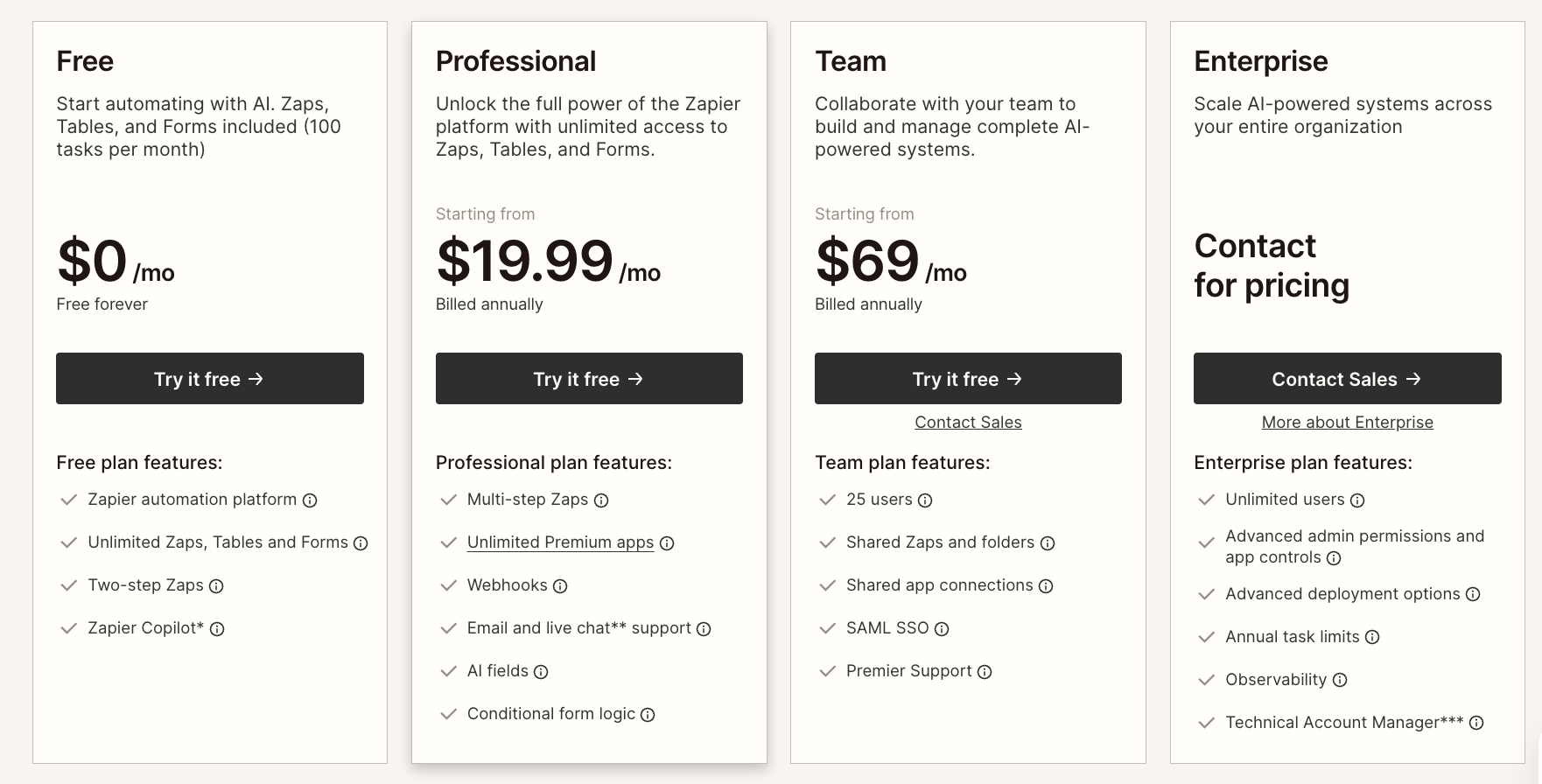
Free: $0/month for 100 tasks, two-step Zaps, Tables, Forms, and Zapier MCP
Professional: $19.99/month (billed annually) for multi-step Zaps, unlimited premium apps, and AI fields
Team: $69/month (billed annually) for 25 users, shared Zaps, and SAML SSO
Enterprise: Custom pricing for unlimited users, advanced admin controls, and observability
AI Agents: Free for 400 activities/month or $33.33/month for 1,500 activities
Chatbots: Free for 2 chatbots, $13.33/month for 5 chatbots, or $66.67/month for 20 chatbots
4.
Relevance AI
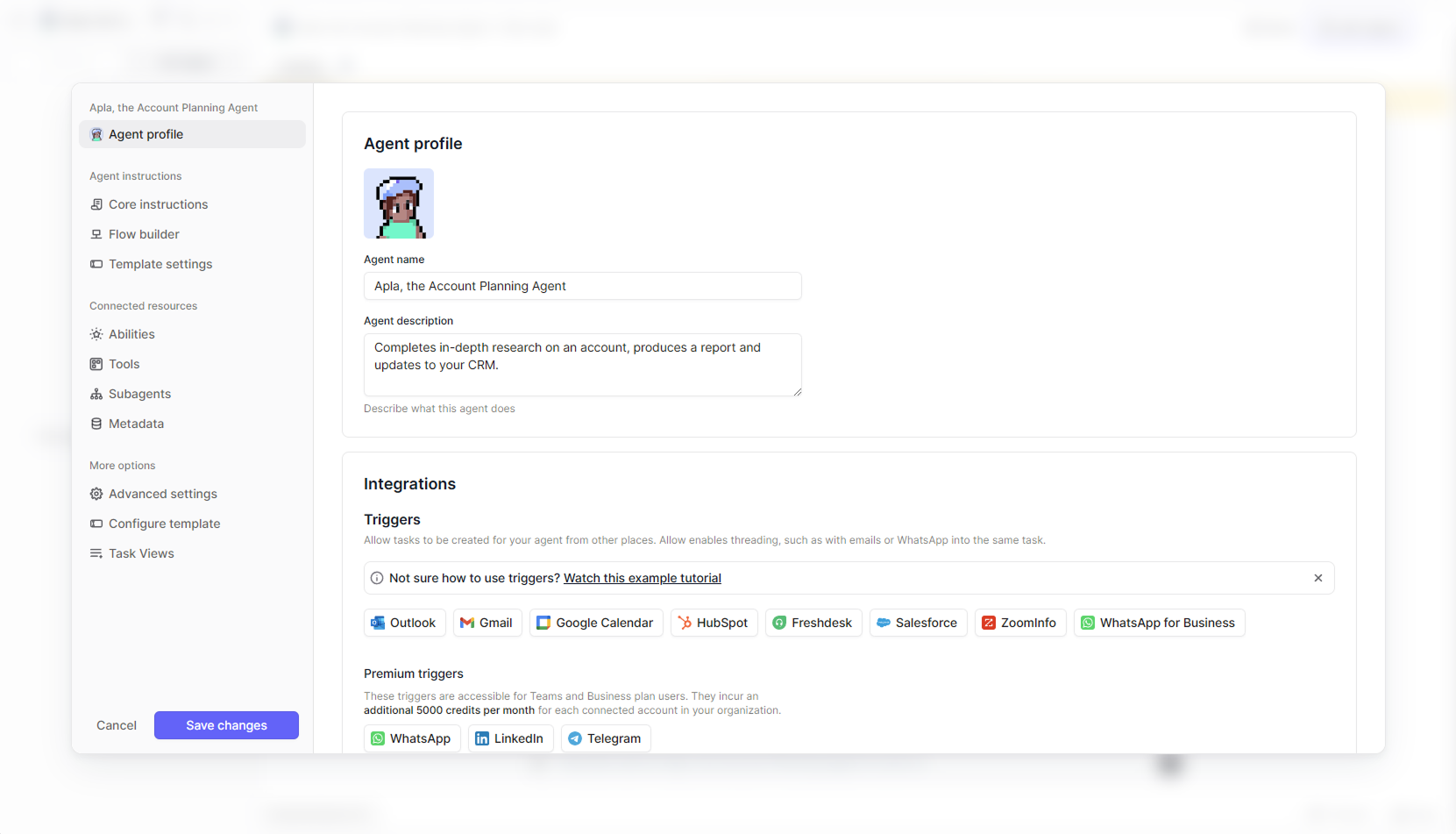
Relevance AI is an enterprise AI workforce platform that enables go-to-market and operations teams to build, deploy, and manage autonomous AI agents. Designed for domain experts, the platform allows users to create custom agents using plain English through its Invent builder. It maps the path from assisted AI copilots to fully self-driving workflows, handling tasks like outbound prospecting, lead qualification, and customer support. With enterprise-grade governance, built-in evaluations, and over 1,000 native integrations, Relevance AI ensures that agents operate safely and effectively at scale.
Product details
Invent builder: Create custom AI agents and tools simply by describing your desired tasks in plain English.
Multi-agent workforces: Deploy teams of specialized agents to handle entire processes like outbound prospecting and inbound qualification end-to-end.
Model routing: Choose the best language model for each task by balancing performance and cost across providers like Anthropic and OpenAI.
Comprehensive evaluations: Set quality thresholds and use built-in evaluation tools to hold your agents to a consistent standard.
Extensive integrations: Connect with over 1,000 native applications out of the box, including HubSpot, Salesforce, Slack, and Gmail.
Enterprise-grade governance: Maintain control with role-based access, single sign-on, audit logs, and automatic PII masking.
Human-in-the-loop: Set approval gates that require human review when an agent is unsure or confidence is low.
MCP support: Build agents programmatically and connect to external tools via the Model Context Protocol.
Pricing
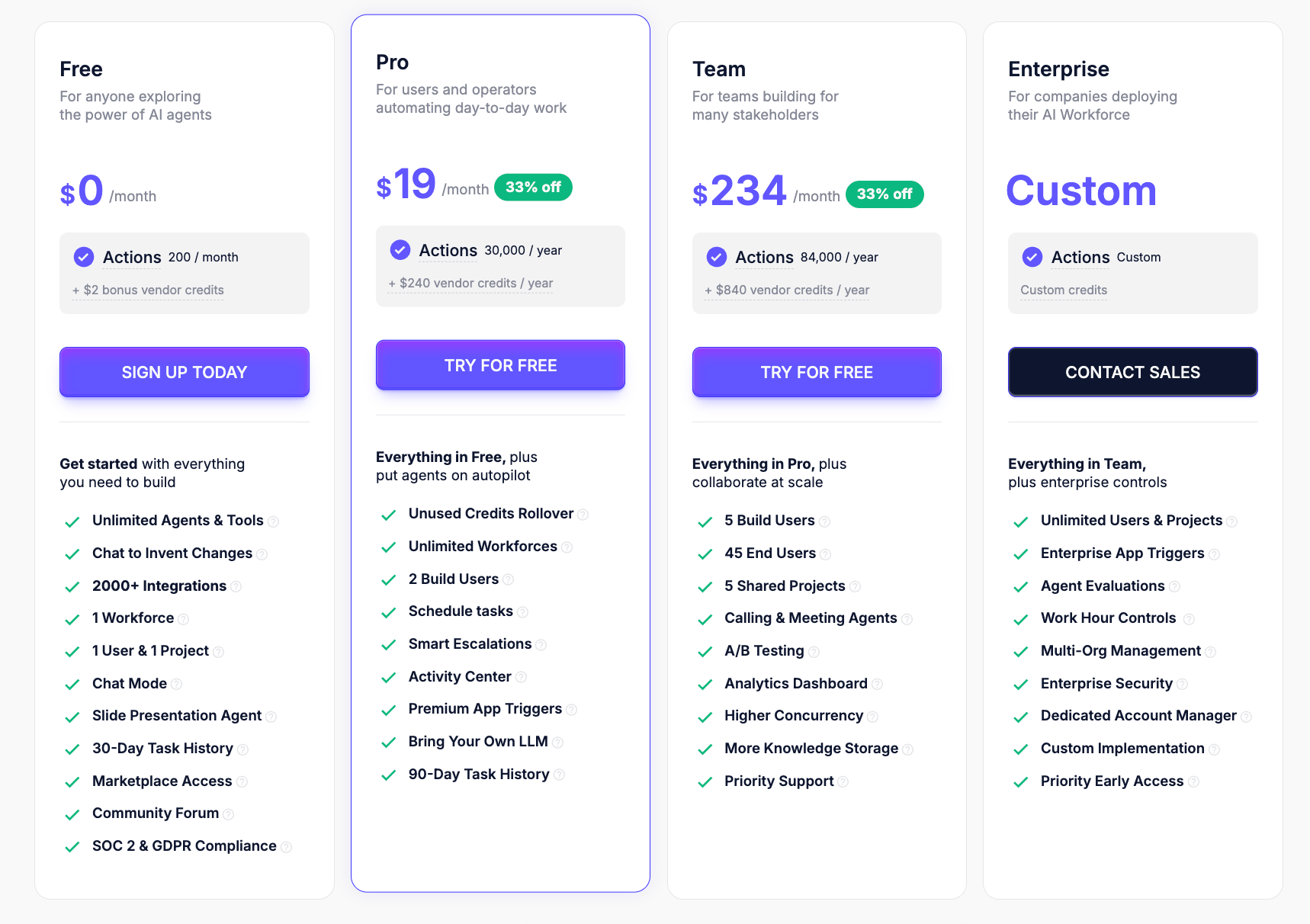
Relevance AI offers a custom plan for companies looking to scale operations with an AI workforce.
Enterprise: Custom pricing for unlimited users, agents, and workforces, including custom actions, agent evaluations, SSO, and a dedicated account manager
5.
n8n
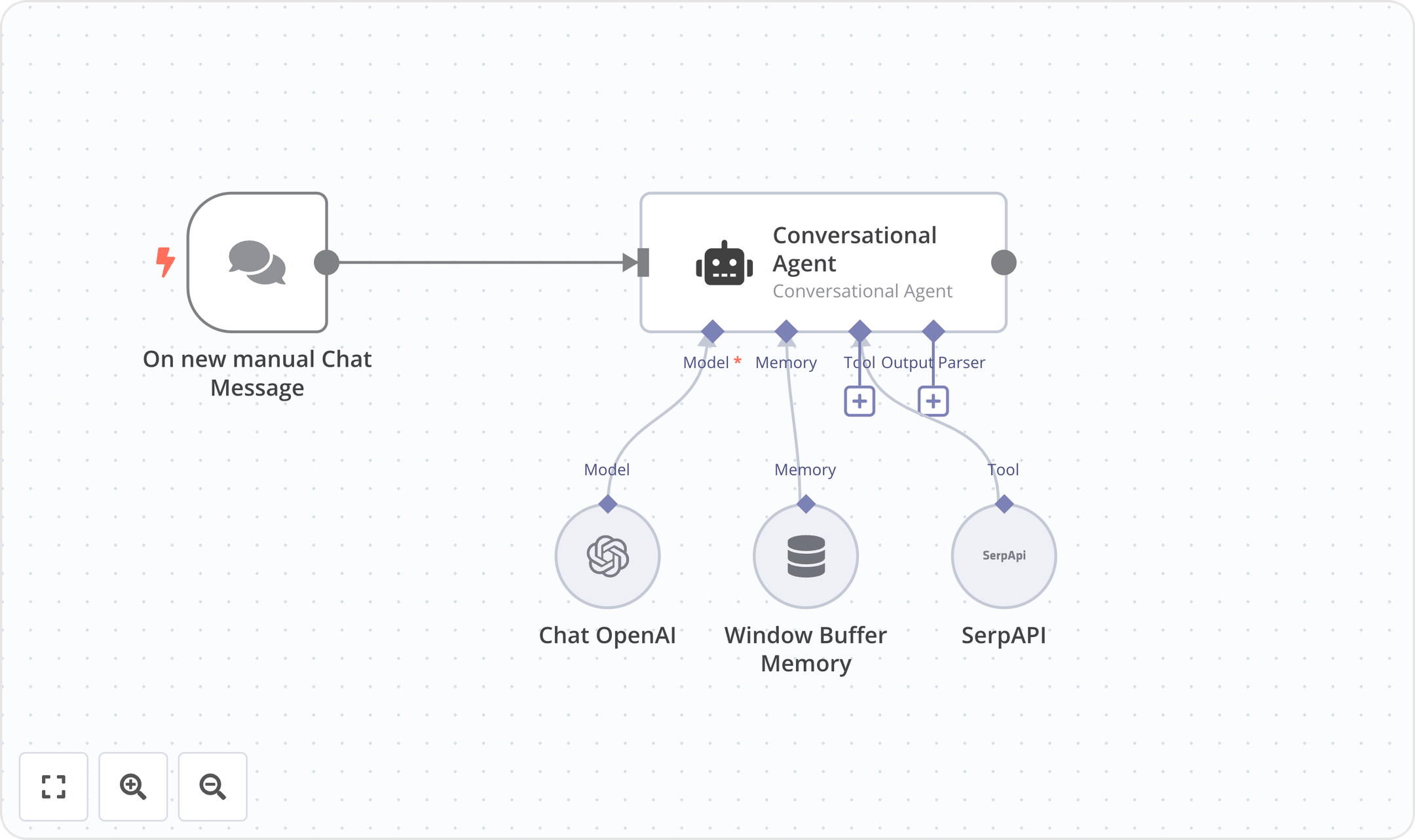
n8n is a source-available workflow automation platform designed specifically for technical teams and developers. It bridges the gap between visual workflow editors and custom code, allowing users to seamlessly blend drag-and-drop nodes with custom JavaScript or Python. By offering robust self-hosting capabilities via Docker alongside cloud-hosted options, n8n provides complete control over data privacy and compliance. Its execution-based pricing and advanced debugging tools make it highly scalable for orchestrating complex API integrations, AI-driven workflows, and mission-critical automated processes.
Product details
Code and no-code blend: Write custom JavaScript or Python directly alongside an intuitive visual workflow editor.
Self-hosting capabilities: Deploy on-premises with Docker and access the full source code on GitHub for complete data sovereignty.
Advanced developer tools: Leverage Git version control, isolated environments, global variables, and detailed execution logs.
AI workflow building: Utilize native AI credits and built-in evaluators to safely test and deploy AI-driven automations.
Predictable execution pricing: Pay per full workflow run rather than per individual step to make scaling costs highly predictable.
Granular debugging: Avoid endless debugging clicks by re-running single steps and viewing detailed execution histories.
Complex logic handling: Architect advanced multi-step workflows with deep internal API integrations and robust error handling.
Enterprise security: Maintain full compliance with SSO, external secret stores, and log streaming to security platforms.
Pricing
n8n offers a free self-hosted community edition alongside cloud-hosted and enterprise plans with execution-based pricing.
Community Edition: $0/month for standard, self-hosted deployments via GitHub
Starter: $20/month (billed annually) for 2.5K workflow executions and 50 AI Workflow Builder credits
Pro: $50/month (billed annually) for 10K workflow executions and 150 AI Workflow Builder credits
Business: €667/month (billed annually) for 40K workflow executions, self-hosted deployment, and Git version control
Enterprise: Custom pricing for custom workflow executions, unlimited shared projects, and dedicated support
Start-up Plan: 50% off the Business tier for eligible companies with under 20 employees

6.
Cassidy
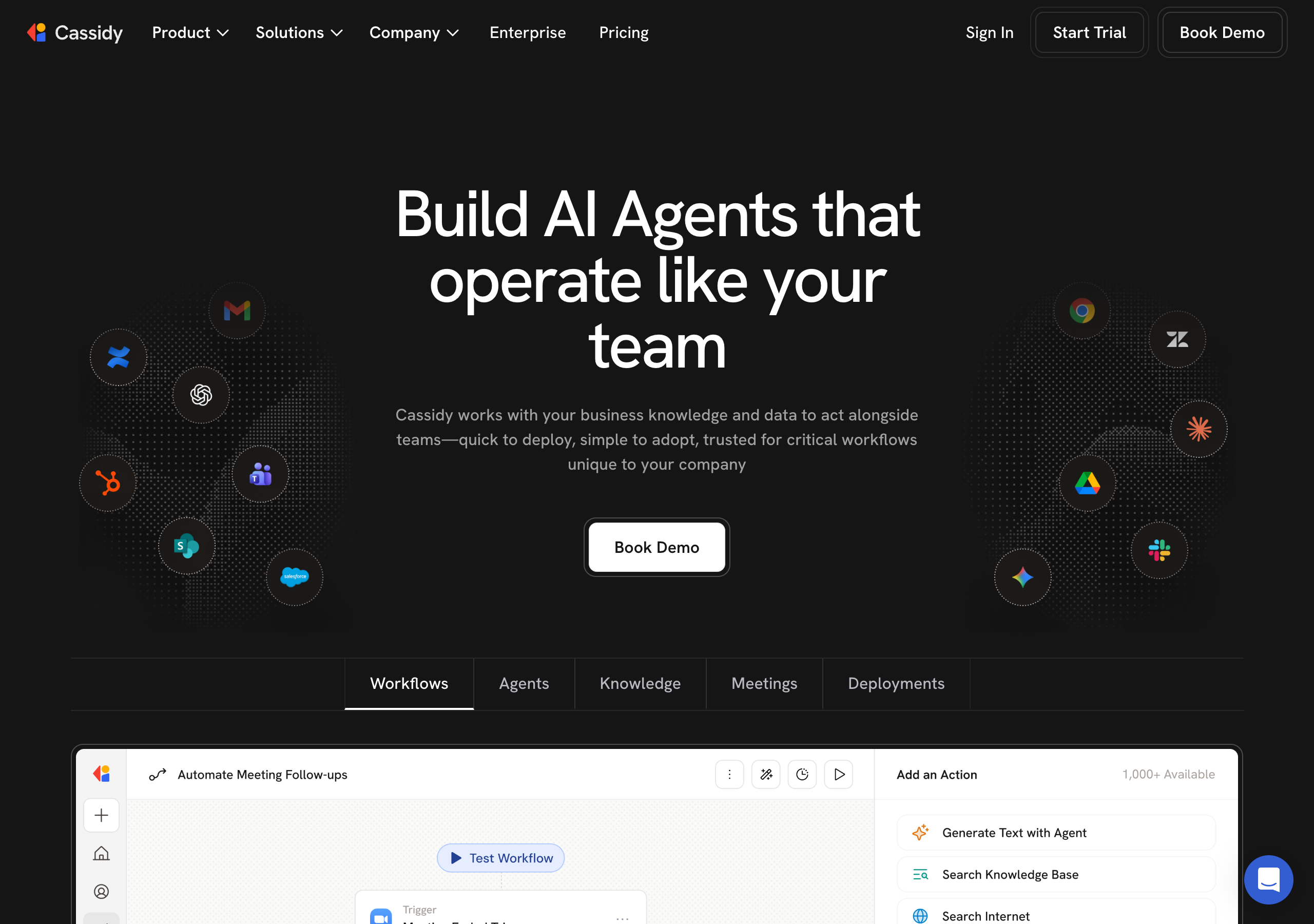
Cassidy is an AI agent platform focused on giving automations deep business context. It connects to your company's documents, wikis, and data sources through a unified knowledge base that continuously syncs, so AI agents always act on the latest information. Cassidy offers no-code workflow creation, agentic reasoning for handling complex logic and exceptions, and cross-system execution across tools like Salesforce, Slack, and Microsoft Teams. It includes human-in-the-loop steps and guardrails for control over business-critical work.
Product details
Unified knowledge base: Gain deep business context via a system that continuously syncs across your documents and data sources.
No-code creation: Enable non-technical teams to build and deploy robust AI agents without developer support.
Agentic reasoning: Handle nuance, complex logic, and exceptions with AI that makes decisions instead of following rigid scripts.
Cross-system execution: Execute actions across multiple systems in a single flow by connecting deeply with your software stack.
Precision and control: Keep full control over business-critical work using guardrails and human-in-the-loop checkpoints.
Seamless deployment: Deploy agents directly into Slack, Microsoft Teams, Google Chrome, and other tools your team already uses.
Enterprise-grade security: Maintain compliance with strict international security standards including SOC 2 Type II, GDPR, HIPAA, and SSO.
Pricing
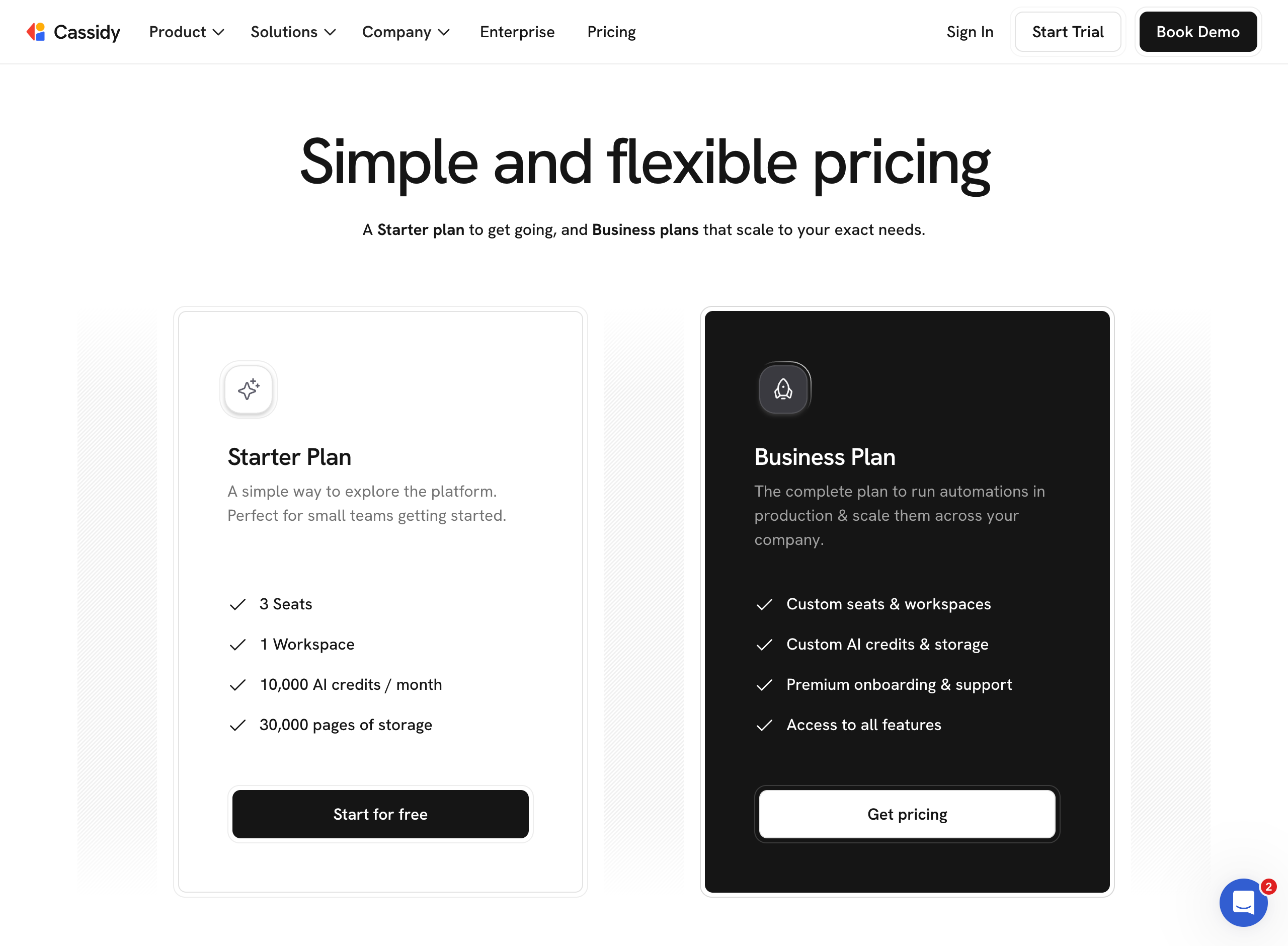
Cassidy offers a free tier for small teams along with custom pricing for businesses needing advanced capabilities.
Starter: Free for 3 users, 5 agents, 5 workflows, 10K AI credits, basic integrations, and 24-hour data sync
Business: Custom pricing for tailored users, agents, workflows, instant sync, advanced integrations, SSO, and a dedicated success manager
7.
Make
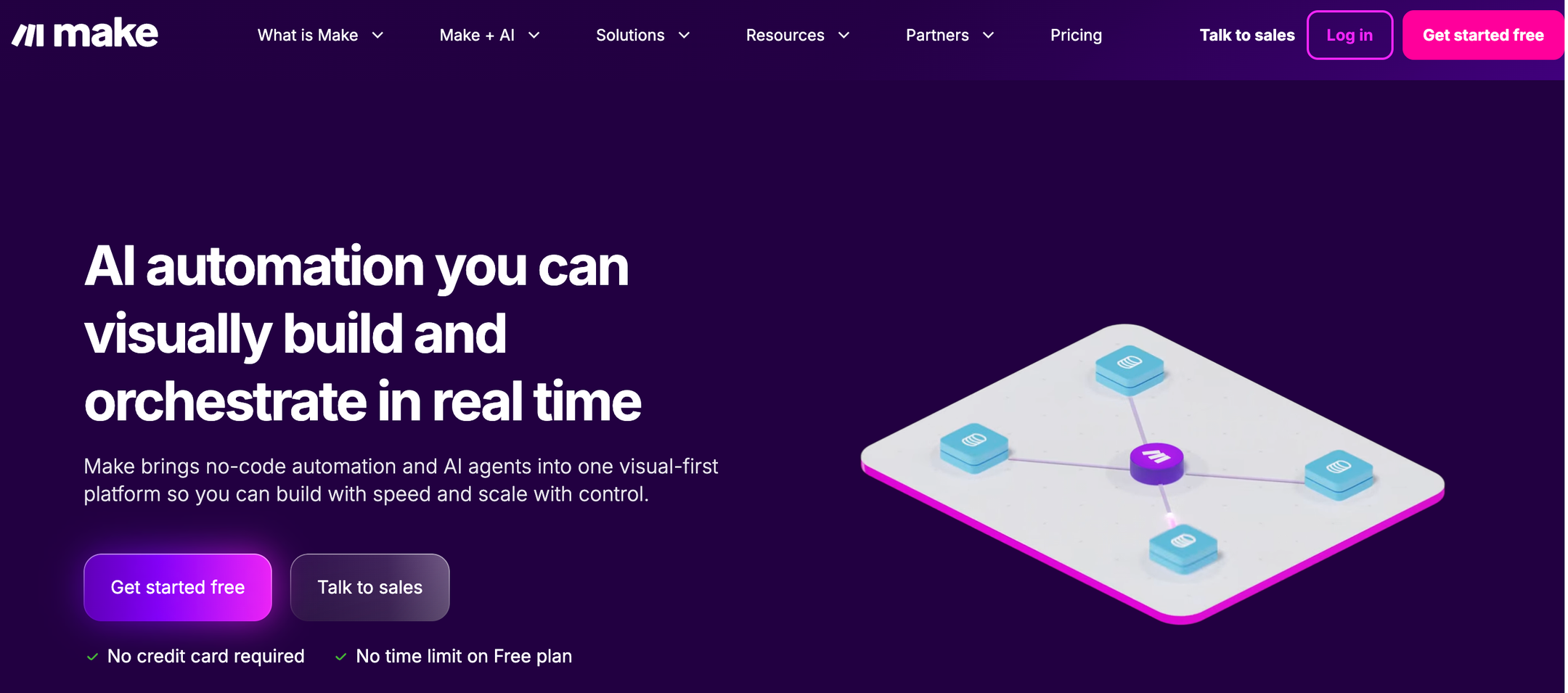
Make is a visual-first no-code automation platform that lets you design complex workflows on a canvas by connecting modules from 3,000+ apps. It supports advanced logic like branching, filtering, iteration, and error handling, making it popular with power users who need more control than simpler tools offer. Make has recently expanded into AI with beta AI Agents, an AI Toolkit, MCP server support, and 400+ AI app integrations including OpenAI, DeepSeek, and Perplexity. Make is well-suited for technical users and teams that need to build sophisticated, multi-step automations with granular control over every step.
Product details
Visual scenario builder: The canvas-based editor lets you see exactly how data flows through your automation, making it great for debugging and complex logic.
Advanced workflow logic: Supports branching, filtering, iteration, and error handling that most simpler tools can't match.
Strong integration library: Connects with 3,000+ apps, with deep action support across most of them.
AI agents and integrations: Connect 350+ AI apps, build and manage AI Agents, and use the Make MCP Server to connect AI from anywhere.
Generous pricing relative to complexity: Make offers more operations per dollar than Zapier, making it attractive for higher-volume automations.
Steep learning curve: Make's power comes at a cost, as non-technical users typically need 10 to 20 hours before feeling comfortable with concepts like routers and iterators.
Pricing
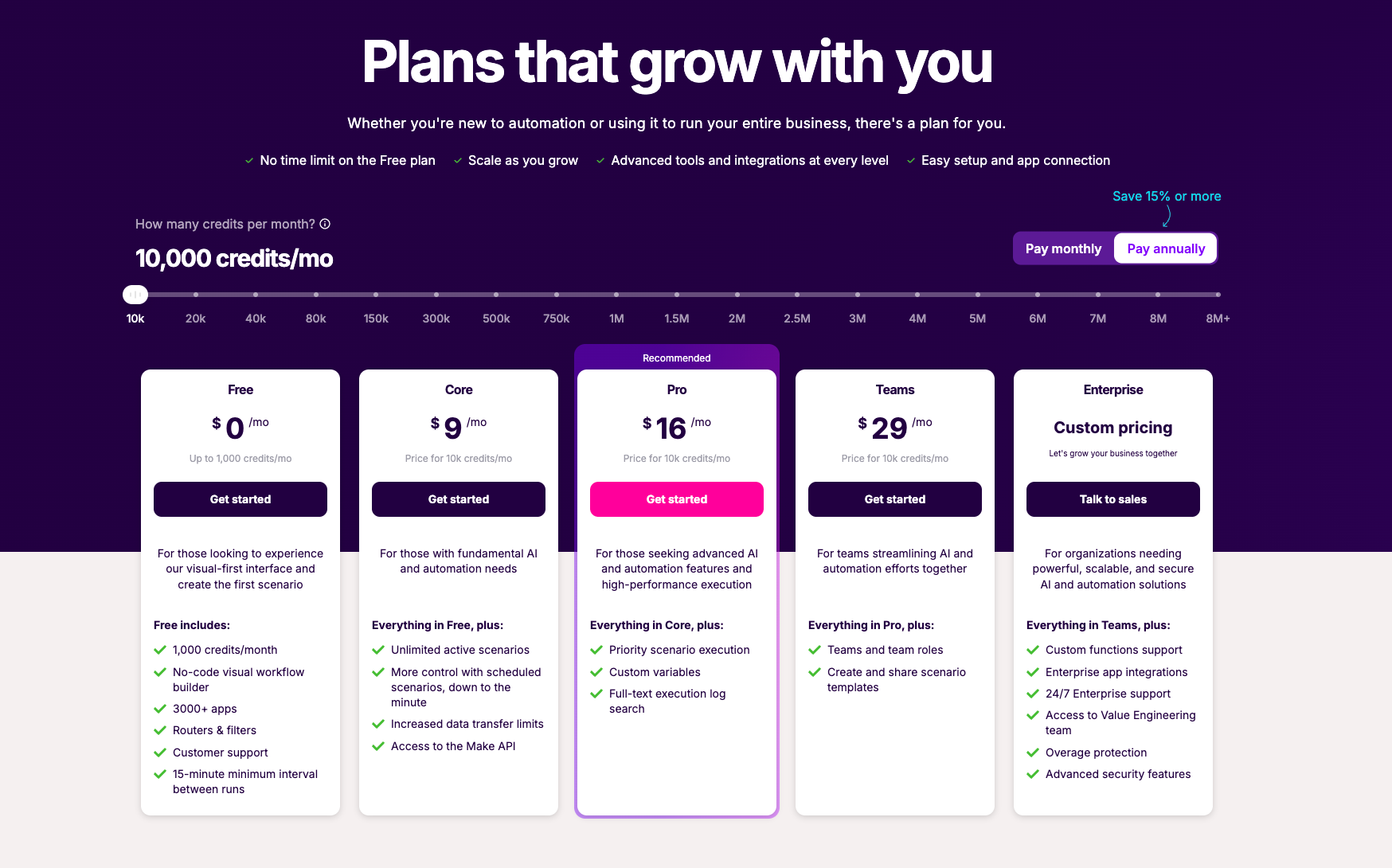
Make offers a free tier for basic needs and paid plans based on monthly credit usage and advanced features.
Free: $0/month for 1,000 credits/month and a no-code visual workflow builder
Core: $12/month for 10,000 credits/month, unlimited active scenarios, and scheduled scenarios
Pro: $21/month for 10,000 credits/month, priority scenario execution, and custom variables
Teams: $38/month for 10,000 credits/month, teams and team roles, and scenario templates
Enterprise: Custom pricing for enterprise app integrations, 24/7 support, and advanced security
8.
Stack AI
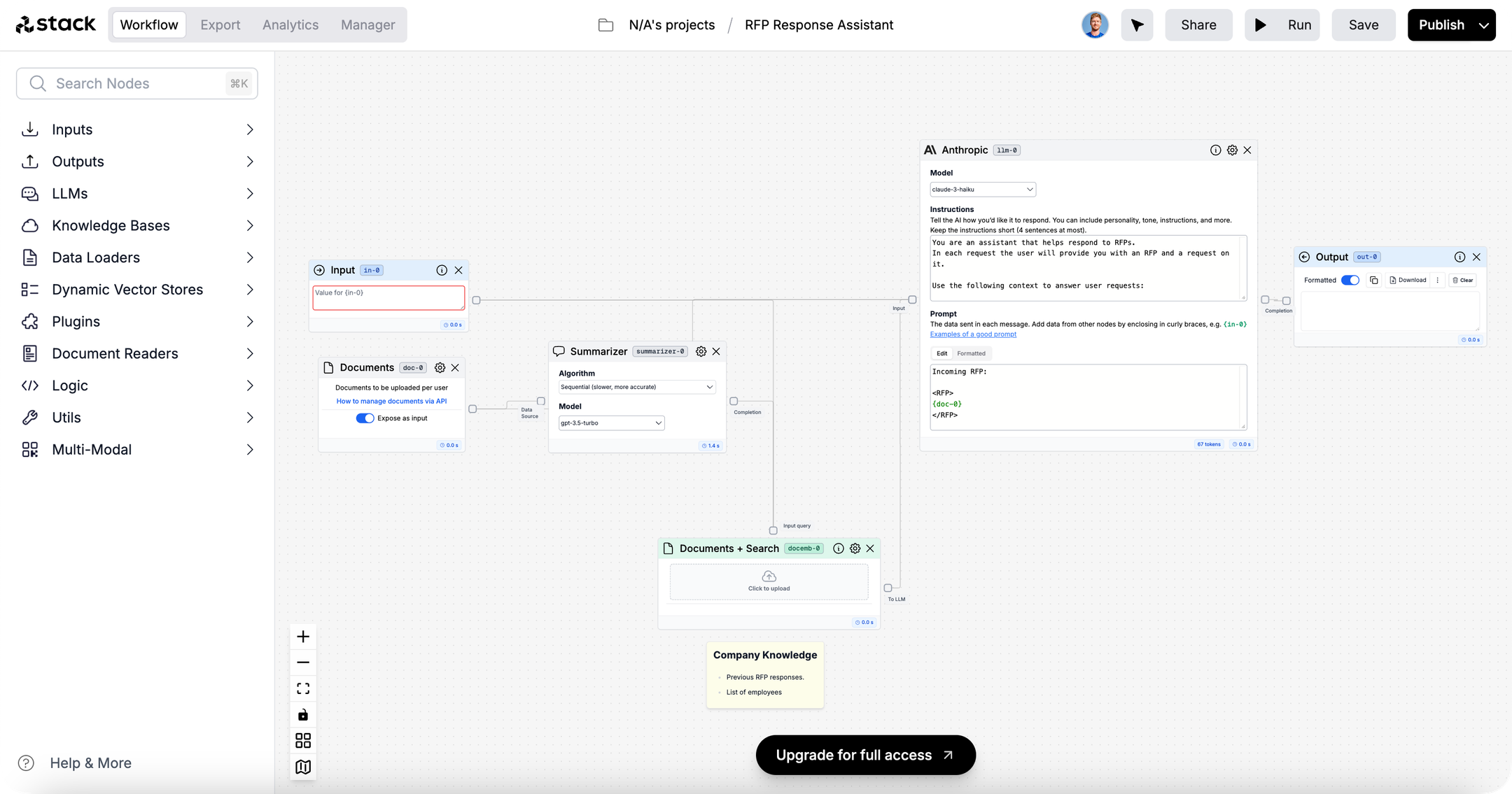
Stack AI is an enterprise-focused platform for building and deploying AI agents, recently acquired by Asana to bring human-agent workflows into a single place. It offers a visual workflow builder for creating agentic workflows, over 100 enterprise integrations, and flexible deployment options. The platform is certified for HIPAA, SOC 2 Type II, GDPR, and ISO 27001, making it an ideal fit for regulated industries like healthcare and finance. Stack AI positions itself as an AI transformation platform for IT and enterprise architecture teams, providing dedicated white-glove support from AI experts to help organizations scale their deployments.
Product details
Agentic workflows: Go from a time-consuming process to a working AI agent in minutes.
Flexible deployment: Supports multi-tenant cloud, VPC, and on-premise deployments to meet strict data residency needs.
Enterprise-grade security: Certified for HIPAA, SOC 2 Type II, GDPR, and ISO 27001 to protect sensitive data.
Human in the loop: Integrate human oversight into automated decision points for total process precision.
LLM agnostic: Deploy the best-performing language model for every specific task.
Extensive integrations: Connect AI agents to over 100 enterprise systems to read, write, and execute tasks.
White-glove experience: Receive dedicated support and hands-on guidance from AI experts.
Pricing
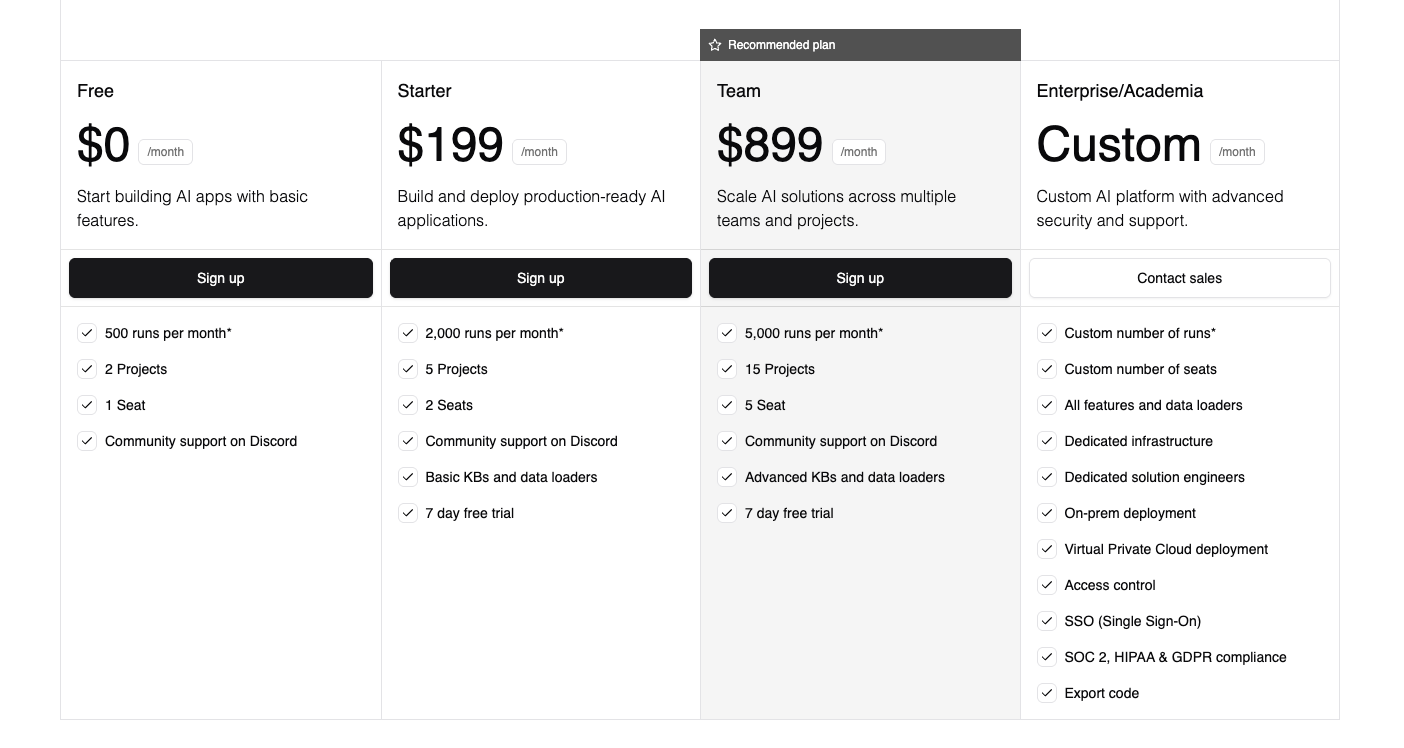
Stack AI offers a free tier to get started and a custom enterprise plan for businesses that require advanced security, dedicated infrastructure, and premium support.
Free: $0/month for 500 runs per month, 2 projects, 1 seat, and community support
Enterprise: Custom pricing for custom runs, unlimited projects, dedicated infrastructure, on-prem deployment, and advanced compliance
9.
Lindy
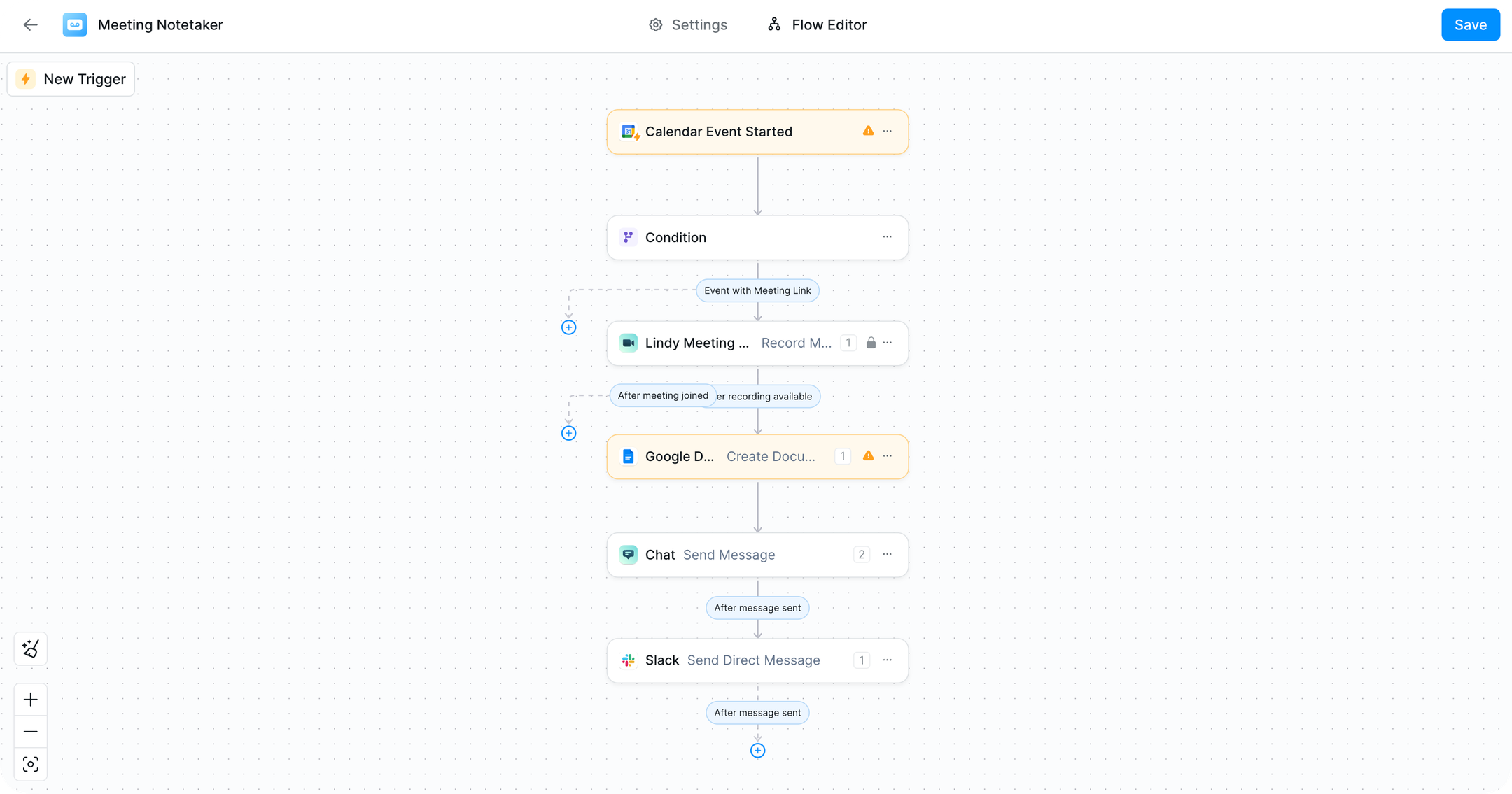
Lindy is an AI personal assistant designed to proactively manage your inbox, meetings, and calendar. Lindy operates as an always-on executive assistant you interact with primarily via iMessage or SMS: You text it requests, and it handles tasks like drafting emails, scheduling meetings, prepping you before calls, and triaging your inbox. It connects with hundreds of integrations (Gmail, Outlook, Google Calendar, Slack, Notion, and more) and learns your communication style and preferences over time. It's positioned as a replacement for a human executive assistant at a fraction of the cost.
Product details
Proactive assistant: Lindy can surface important context, share meeting prep, and flags items before you ask it.
iMessage/SMS interface: Works anywhere you can text, 24/7, no need to open a separate app or dashboard.
Learns your style over time: Adapts to your writing voice, priorities, and preferences through ongoing feedback and usage.
Enterprise-grade security: GDPR, SOC 2, HIPAA, and PIPEDA compliant with encryption and no data used for model training.
No longer a workflow automation builder: While Lindy's interface offered a visual workflow building experience in the past, the company has since pivoted to become a virtual agentic personal assistant.
Requires customization to work the way you want it to: In our team's testing, not all of the assistant's default proactive behavior was desired. You'll need to spend a bit of time talking with Lindy to understand exactly what it does for you and how to customize it.
Pricing
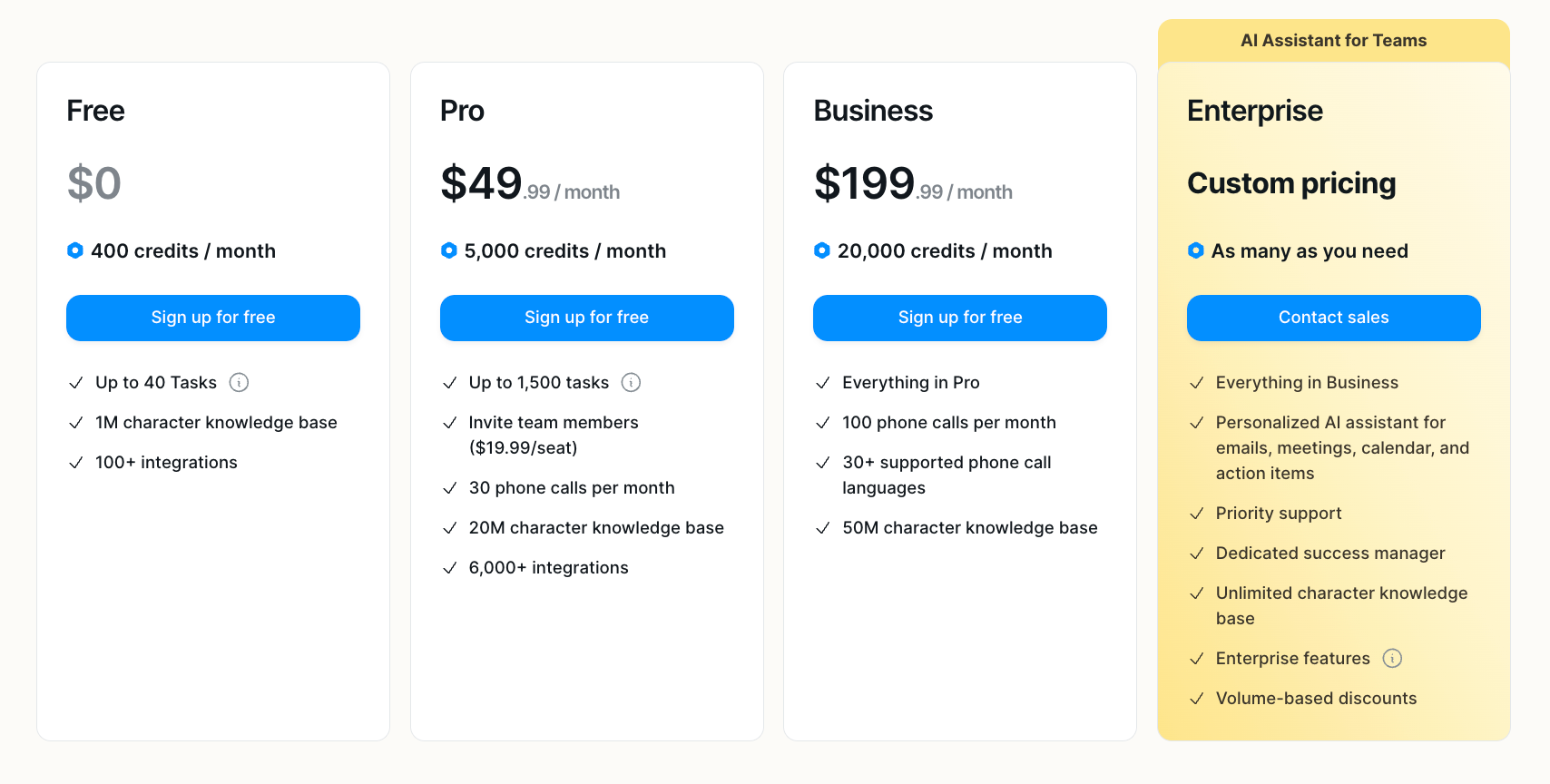
Lindy has no free plan, but you can try it for a 7-day trial.
Plus: $49.99/month for standard usage, up to 2 inboxes, iMessage/SMS access 24/7, email drafting, meeting scheduling, meeting prep, and hundreds of integrations
Pro: $99.99/month for 3x the usage of Plus, up to 3 inboxes, and computer use
Max: $199.99/month for 7x the usage of Plus and up to 5 inboxes
Enterprise: Custom pricing for everything in Max, audit logs, SSO, SCIM, dedicated support, onboarding and enablement, and HIPAA compliance
10.
Tray

Tray.ai is an AI orchestration platform that combines a traditional iPaaS with AI agent development and integration capabilities. Its Merlin Agent Builder allows teams to create intelligent agents that reason, act, and learn across connected systems, while its Agent Gateway enables the secure deployment of managed MCP servers. The platform features over 700 pre-built connectors, agent accelerators for IT and HR, and enterprise-grade governance including audit trails, guardrails, and role-based access control. Designed for large business and development teams, Tray focuses on scaling trusted AI agents and consolidating complex enterprise integrations into a single automated platform.
Product details
Agent Builder: Create conversational, event-driven, or fully autonomous AI agents with guardrails and identity protection.
Agent Gateway: Deploy secure and governed Model Context Protocol (MCP) servers across your organization.
Extensive integrations: Connect securely to over 700 off-the-shelf connectors to reduce enterprise integration sprawl.
Pre-built accelerators: Speed up time-to-value with ready-to-use agents designed specifically for ITSM and HR workflows.
Enterprise governance: Centralize observability, security, and role-based access control across all agents and automations.
Flexible multi-LLM support: Choose the best language model for each specific enterprise use case.
Intelligent iPaaS: Infuse intelligence into existing business processes and manage data across complex enterprise systems.
Pricing
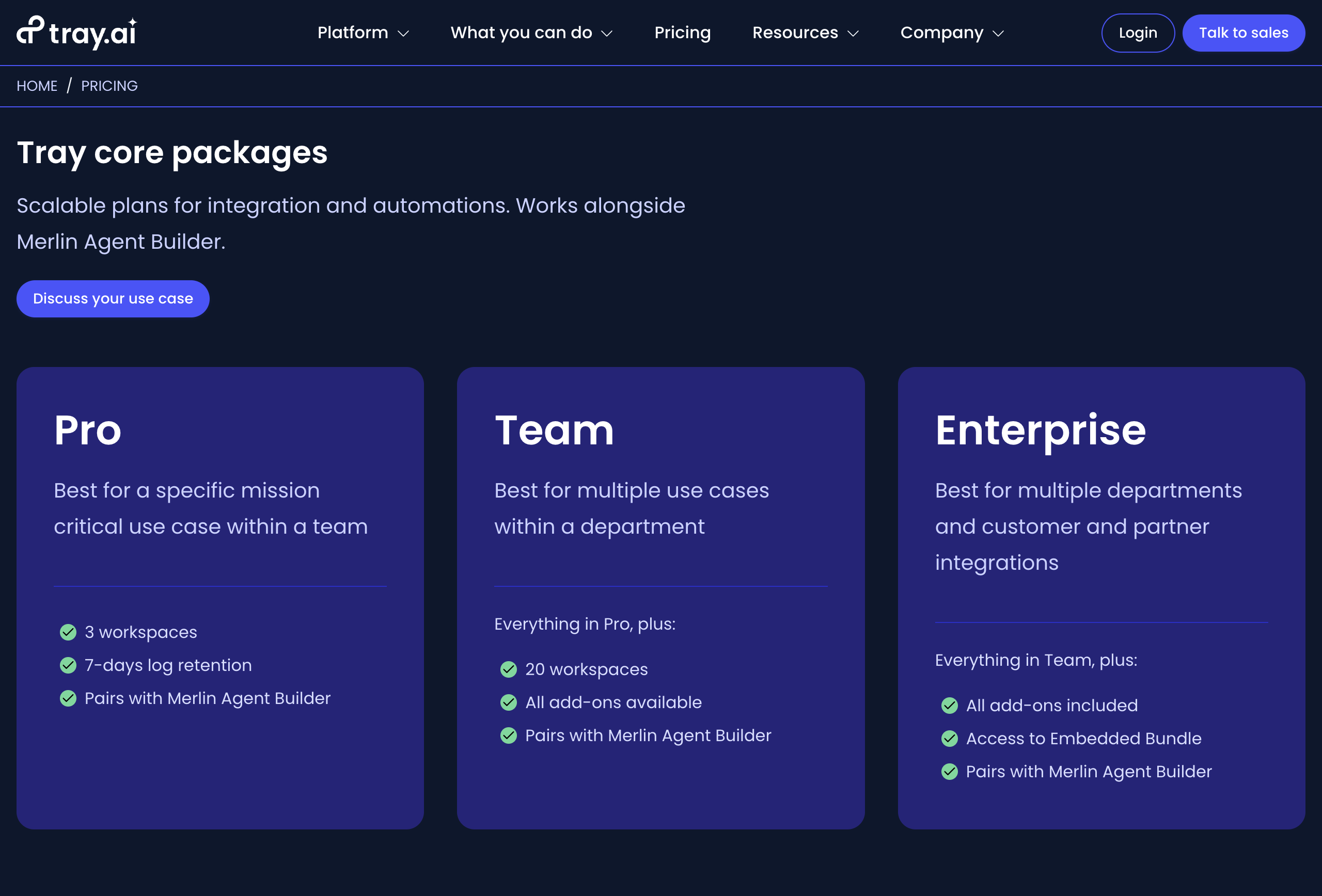
Tray.ai offers custom pricing tailored to specific business needs. All paid plans require contacting the sales team for a custom quote, with AI and MCP capabilities available as add-ons.
Pro: Custom pricing for 3 workspaces, 7-day insights, 7-day log retention, and 700+ connectors
Team: Custom pricing for 20 workspaces, 30-day insights, and access to all available add-ons
Enterprise: Custom pricing for unlimited workspaces, 180-day insights, advanced on-premise deployments, SSO, and HIPAA compliance
Tray Agent Gateway: Custom pricing add-on to create governed and managed MCP services with observability
Merlin Agent Builder: Custom pricing add-on to build AI agents with guardrails, knowledge ingestion, and pre-built accelerators
How to make your choice
Still not sure which platform to pick? Answer these four questions:
Question 1: What's your technical comfort level?
"I'm not technical at all" → Start with Relay.app. You can build agents using natural language without touching any technical configuration.
"I can follow tutorials and learn new tools" → Consider Gumloop, Zapier, Cassidy, or Relevance AI. These have visual builders or no-code interfaces that take some learning but don't require coding.
"I'm a developer or have one on my team" → Look at n8n. You'll get maximum flexibility and can customize everything. Make is another strong option if you prefer a visual canvas with advanced logic.
Question 2: How important is human oversight?
"Critical, AI can't take actions without my approval" → Relay.app has the best human-in-the-loop features. You can require approval before any action executes.
"I want visibility but don't need to approve everything" → Most platforms work here. Prioritize based on other factors.
Question 3: What tools do you need to connect?
"Mostly common tools (Google Workspace, Slack, CRMs, etc.)" → Any platform on this list will work. Choose based on ease of use and price.
"I need connections to obscure or legacy tools" → Zapier (8,000+ integrations) or n8n (can connect to any API) are your best bets.
"I primarily need AI capabilities, integrations are secondary" → Gumloop or Relevance AI focus more on AI power than integration breadth.
Question 4: Do you have enterprise or compliance requirements?
"Yes, we're in a regulated industry (healthcare, finance, defense)" → Stack AI (HIPAA, SOC 2, ISO 27001, on-prem deployment) or Tray (enterprise iPaaS with full IT governance and the Merlin Agent Builder) are purpose-built for this.
"We need AI that's deeply grounded in our internal company knowledge" → Cassidy connects to your docs, wikis, and data sources to give agents real business context, no coding required.
"Standard security is fine" → Any platform on this list will cover you. Focus on ease of use and features instead.
The bottom line
After testing all of these platforms extensively, here's my honest take:
For 80% of people reading this, Relay.app is the right choice. It's the easiest to use, has the best human-in-the-loop controls (which you'll thank yourself for later), and the pricing is fair. The integration library is still growing, but it covers the tools most businesses actually use.
If you want the most AI-native building experience, Gumloop is worth a serious look. Its visual canvas for multi-agent orchestration is impressive, and access to all major AI models under one subscription keeps things simple.
If Relay.app doesn't have an integration you need, check Zapier first. It connects to everything, and while its AI features aren't as sophisticated, you can pair it with other tools.
If your focus is sales and GTM, Relevance AI was built specifically for that. Its pre-built agent templates for BDR, research, and inbound qualification can get your revenue team up and running fast.
If you're technical and want full control, n8n is the choice for you. Self-host it, customize it, and pay nothing (or very little). The trade-off is complexity. You're on your own for setup and maintenance.
If you want AI agents that truly understand your business, Cassidy is a smart pick. Its Knowledge Base connects your docs, SOPs, and company data so agents respond with real context, not generic AI output.
If you need a visual automation powerhouse, Make gives you a canvas-based editor with branching, filtering, and iteration that power users love. Its AI capabilities are catching up, though the learning curve is steeper than simpler tools.
If you're in a regulated enterprise, Stack AI and Tray are worth a serious look. Stack AI brings HIPAA, SOC 2, and on-prem deployment for the most sensitive environments. Tray gives IT teams a governed platform to build and manage agents across the entire stack with its Merlin Agent Builder.
If you need a personal AI assistant rather than an agent builder, Lindy is worth a look. It's an always-on executive assistant that manages your inbox, calendar, and meetings via iMessage. Great for busy professionals, though it's not a platform for building custom agents.
The AI agent space is moving fast. The platform that's right for you today might not be right in a year. Start with something that gets you results quickly, learn what you actually need, and be willing to switch if something better comes along. And the best way to learn is by doing, so start building!
Jacob Bank
Founder/CEO at Relay.app

Jacob is the Founder and CEO of Relay.app. Prior to founding Relay.app, Jacob was a Director of Product Management at Google, where he led the product teams for Gmail, Google Calendar, and several other Google Workspace products. Before that, Jacob was the Co-founder and CEO of Timeful (acquired by Google in 2015), a smart calendar that leveraged insights from behavioral psychology and AI to help people spend time on their most important priorities. He has a BA in Computer Science from Cornell University and was pursuing a PhD in the AI Lab at Stanford before dropping out to found Timeful.
FAQs
Should I use a general-purpose AI agent or a workflow automation tool for my business?
It depends on the task. General-purpose AI agents are flexible and great for open-ended work like research or drafting, but they can be unpredictable and expensive for repetitive processes. Workflow automation tools are purpose-built for structured, repeatable tasks (think lead routing, customer onboarding, or approval chains) where you need consistency and reliability every time. For most business operations, a platform like Relay.app gives you the best of both worlds: It's an AI agent builder with powerful workflow automation, human-in-the-loop controls, and MCP support, so you get AI intelligence where you need it, with predictable execution.
Can Relay.app handle specific use cases better than a general AI agent like ChatGPT or Claude?
Yes, for structured and repeatable use cases. General AI agents are powerful conversational tools, but they aren't designed to integrate with your apps, trigger automatically, or include team-based approvals. Relay.app connects to 100+ apps and lets you build workflows for specific use cases, like auto-triaging support tickets, routing sales leads, or generating reports on a schedule, with human-in-the-loop checkpoints built in. It's the difference between asking an AI to do something once and having a system that does it reliably every time.
What's the difference between AI agents and workflows?
AI agents (like Claude Cowork or OpenClaw) handle open-ended, one-off tasks by dynamically deciding what to do next. Automated workflows (like those built in Relay.app) follow structured, repeatable steps that trigger automatically and run the same way every time. For most repeated business processes, like lead routing, onboarding, and reporting, you want the consistency of a workflow. For ad-hoc knowledge work like research or drafting, an AI agent is better. You can use both together!
Can I use OpenAI workspace agents for free?
No, OpenAI workspace agents are currently available only as a research preview on ChatGPT Business, Enterprise, Edu, and Teachers plans. If you need AI-powered automation but don't want to commit to an enterprise ChatGPT subscription, workflow automation tools like Relay.app offer a more accessible alternative.
Can OpenAI workspace agents connect to external apps?
OpenAI workspace agents are primarily designed to work within the ChatGPT environment and can interact with some tools through connectors, but their integration catalog is still limited compared to dedicated automation platforms. Workflow automation tools like Relay.app, Zapier, and Make offer deep, native integrations with 200+ apps including CRMs like HubSpot and Salesforce, project management tools like Asana and Notion, and databases. If your workflows depend on reliably moving data between multiple business apps, a dedicated workflow automation tool will give you much deeper connectivity than workspace agents currently offer.
How do OpenAI's workspace agents compare to workflow automation tools like Relay.app?
OpenAI's workspace agents are Codex-powered agents inside ChatGPT that can handle tasks like preparing reports, writing code, and responding to messages for teams. They run in the cloud and are designed to be shared within an organization. However, they operate primarily within the ChatGPT ecosystem and require a ChatGPT Business, Enterprise, or Edu plan. Relay.app is a dedicated workflow automation platform that connects to 200+ external apps, triggers automatically based on real-world events, and includes built-in human-in-the-loop approvals. If you need deep cross-app automation with structured approval workflows, Relay.app is purpose-built for that. Workspace agents are better suited for ad-hoc knowledge tasks within ChatGPT.